
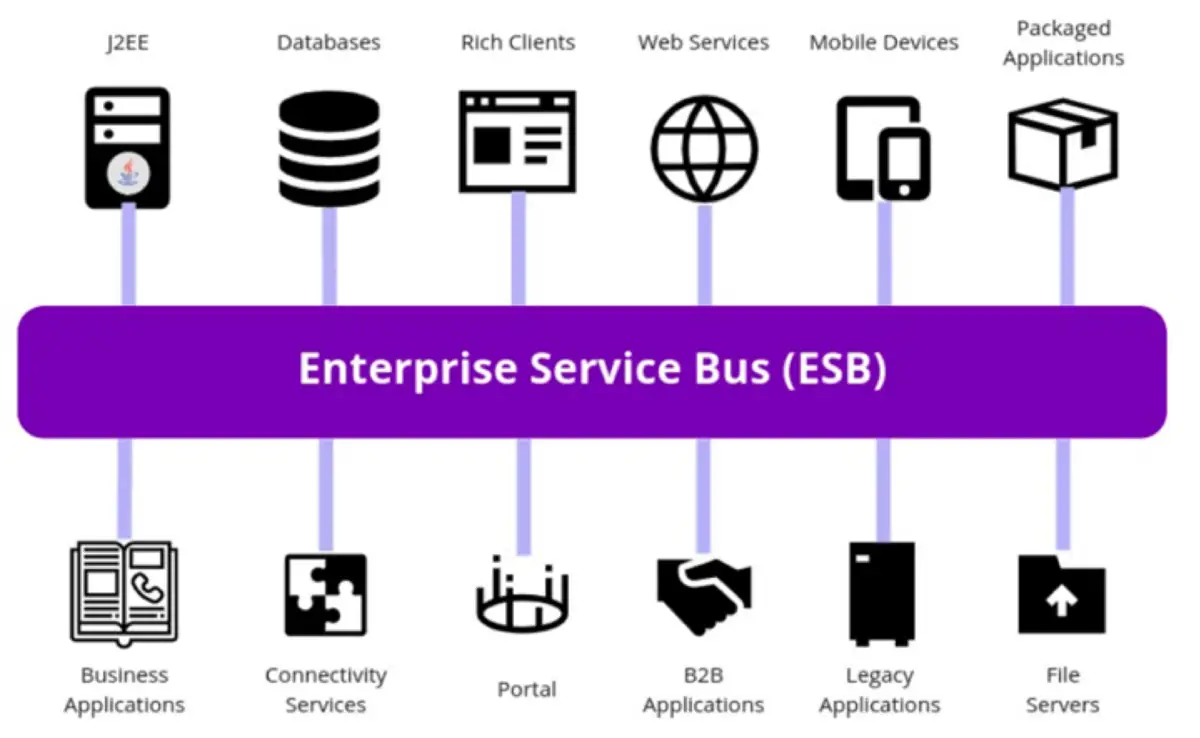
Rapid Integration Across the Enterprise
Karemind ESB is an Enterprise Service Bus that allows companies to integrate applications and processes across the extended enterprise using a standards-based, Service Oriented Architecture (SOA). With a REST-based, highly distributed, yet centrally managed architecture, Karemind ESB overcomes the problems of monolithic integration brokers and application servers. It enables companies to draw on existing business logic residing anywhere within the enterprise to rapidly assemble efficient solutions for business problems.
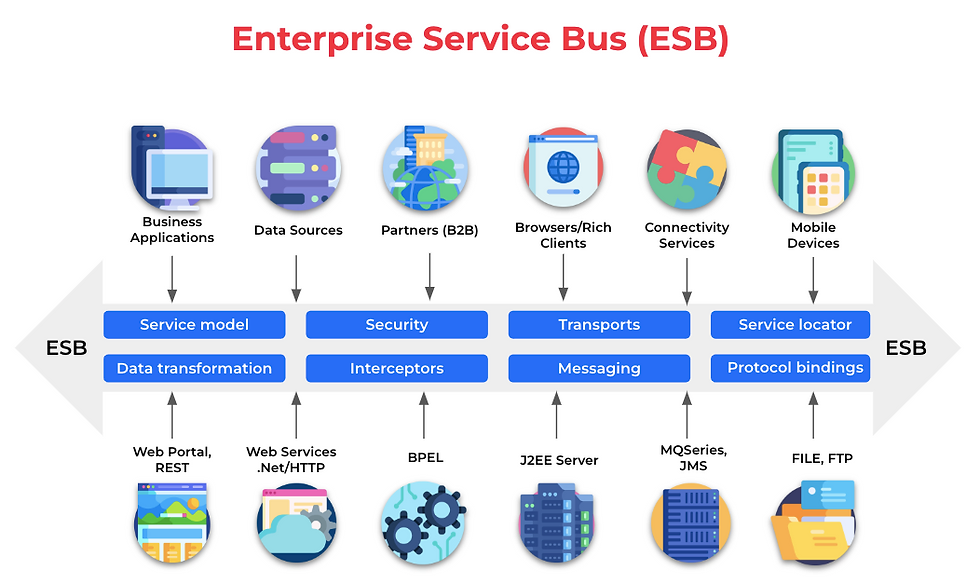
ESB – Enabling Standards-Based Integration
Karemind ESB is a JMS messaging-based ESB that mediates and manages interactions between heterogeneous services across the extended enterprise. It reduces complexity and increases flexibility by enabling the creation of dynamically configurable event-pipelines between distributed services, obviating hardcoded dependencies. With a REST-based, peer-to-peer architecture, the Karemind ESB enables linear, build-as-you-grow scalability with no performance bottlenecks and 24x7xforever availability. Karemind ESB is the foundation for an enterprise-wide SOA, allowing enterprises to integrate applications and processes as standards-based, event-enabled services over a distributed, centrally managed infrastructure.The proven leader in large-scale, mission-critical deployments, Karemind ESB was architected with reliability and flexibility in mind, allowing a logical application design to be mapped directly to the physical implementation, making the development process more intuitive and easier than that of conventional integration suites. Karemind ESB's distributed services architecture enables effective reuse, providing the ability to extract business-value from existing business and legacy applications and allowing the easy coordination of processes across heterogeneous networks. Key features and benefits include:
Distributed Services Architecture
Event-Driven Service Model
Karemind ESB is a JMS messaging-based ESB that mediates and manages interactions between heterogeneous services across the extended enterprise. It reduces complexity and increases flexibility by enabling the creation of dynamically configurable event-pipelines between distributed services, obviating hardcoded dependencies. With a REST-based, peer-to-peer architecture, the Karemind ESB enables linear, build-as-you-grow scalability with no performance bottlenecks and 24x7xforever availability. Karemind ESB is the foundation for an enterprise-wide SOA, allowing enterprises to integrate applications and processes as standards-based, event-enabled services over a distributed, centrally managed infrastructure.The proven leader in large-scale, mission-critical deployments, Karemind ESB was architected with reliability and flexibility in mind, allowing a logical application design to be mapped directly to the physical implementation, making the development process more intuitive and easier than that of conventional integration suites. Karemind ESB's distributed services architecture enables effective reuse, providing the ability to extract business-value from existing business and legacy applications and allowing the easy coordination of processes across heterogeneous networks. Key features and benefits include:
Distributed, Dynamic Deployment and Management
Enables service deployment across the ESB infrastructure from any centralized location, allowing each individual service to be independently configured, managed, updated and redeployed without disrupting other services or processes.
Event-Driven Process Orchestration
By enabling event-flows between distributed services to be set up dynamically by the underlying middleware, allows the logical process design to be mapped directly to physical services distributed across the ESB, empowering non-technical businessusers to compose, deploy and modify event-driven business processes
Distributed, Dynamic Deployment and Management
Enables service deployment across the ESB infrastructure from any centralized location, allowing each individual service to be independently configured, managed, updated and redeployed without disrupting other services or processes.
Lifecycle Management and Versioning
By enabling event-flows between distributed services to be set up dynamically by the underlying middleware, allows the logical process design to be mapped directly to physical services distributed across the ESB, empowering non-technical businessusers to compose, deploy and modify event-driven business processes
Lifecycle Management and Versioning
Enables controlled deployment of business processes across network endpoints, together with automatic transitions across the software lifecycle (development, QA, staging and production) via customizable services and process profiles.
XML Transformations
Supports sophisticated XSLT transformations with pluggable external transformation engines. Enables assertion-based verification of processes via XSD/DTD port matching.
Peer-to-Peer, REST-based Communications Backbone
Unbounded Performance and Scalability
Peer-to-Peer messaging obviates the need for events to traverse a central hub, enabling concurrent event-flows between distributed services, obviating any single points of failure within the infrastructure
Service-Level Failover and 24x7xForever Availability
Enables failover instances of services to be dynamically deployed on remote ESB nodes based on multiple triggers, creating self-healing application networks with continuous availability under all operating environments
Comprehensive Security
Provides a flexible framework for authentication, authorization and encryption, with support for J2EE, LDAP and other security standards, adapting to a wide range of federated enterprise security policies.
ESB Generic Services and Adapters
Distributed Intelligent Routing
Enables dynamic changes to be seamlessly incorporated into running processes by automatically routing events between distributed ESB Services.
Monitoring, Logging and Auditing
Supports asynchronous event-based notification of critical errors in eventdriven business processes, with dynamic tracing, logging, auditing and monitoring of messages, documents and services.
Adapters and Pre-built Services
Ships with a rich set of pre-built enterprise services including adapters to all popular relational databases, files, Messaging Middleware (MQSeries, JMS, MSMQ, others), Web Services, EJB, FTP, SMTP and more.
Advantages of a Standards-Based Solution
Karemind ESB implements standards for communication, connectivity, transformation and security, enabling application interoperability and allowing skills and software-assets to be easily transferred between integration projects. Karemind supports and drives industry standards for integration, including Java, Web Services and XML.
Mitigating Proprietary Dependencies:
Proprietary integration solutions 'lock-in' customers by forcing them to code to non-standard APIs, inhibiting flexibility, preventing reuse and ultimately proving to be extremely expensive. Karemind ESB's standards-based, service oriented approach, however, smoothes the operational path of the processes running a business, reducing the time, effort and cost of integrating applications.
Reuse of Software Assets:
The adoption of a standards-based, Service Oriented Architecture (SOA) allows existing legacy and packaged applications within an organization to be used as building blocks, enabling their reuse within enterprise business processes, driving down development and management costs. With a quicker learning curve, standards further enable development skills and resources to be effectively reused across projects
Seamless Connectivity:
The emergence of connectivity standards including Web-Services, JMS, J2EE-JCA and .NET allow Karemind ESB to seamlessly integrate multiple enterprise assets including application servers, messaging middleware, legacy systems and mainframe applications, without requiring custom coding or application rewrites; standards shield users from version and API changes, ensuring that existing processes are not disrupted by new releases.
Easy Interoperability:
Support for Web Services and other standards within Karemind ESB enables seamless interoperability of disparate applications distributed across heterogeneous platforms; applications can now exchange data with ease, without the need for expensive custom transformations, extra coding or language translation capabilities.
Karemind ESB Business Benefits
Karemind ESB offers a number of benefits over existing solutions for integration and real-time enablement, including faster implementation and deployment cycles, a flexible platform for future expansion offering a high degree of reuse, easy extensibility, seamless interoperability and an improved ROI. Key advantages include:
Dynamic Responsiveness
Deployed as service-oriented processes, solutions on the Karemind ESB improve responsiveness to changing business requirements, minimizing impact on existing business applications and often eliminating the need for new packaged applications. Karemind ESB is based on an event-driven, asynchronous, message-based service-oriented architecture, providing the ability to rapidly specify controlled changes to operations based on business objectives, and to implement these changes directly, quickly and more efficiently for business agility and integrity.
Reduced Training Costs
Karemind ESB improves the productivity of organizations by including a variety of pre-built services necessary for the creation of service-oriented processes, together with tools to componentize existing enterprise software assets. Comprehensive support for industry standards, including J2EE, .NET, XML and Web-Services, ensure a fast learning curve, allowing developers and even enterprise managers to quickly become proficient at synthesizing custom solutions to problems in the form of interactive service-oriented processes.
Increased Revenue
With in-built support for business-to-business interactions, Karemind ESB enables seamless connectivity across the extended enterprise for transacting business in real-time with customers, trading partners and distributors worldwide. Streamlined processes translate into increased revenue, lower costs and open up possibilities of innovation to find newer sources of revenue. Karemind ESB's architectural-level innovations enable linear, build-as-you-grow scalability.
Accelerated Time to Market
Karemind ESB enables the creation of interactive, end-user service-oriented processes without programming, by orchestrating existing services with visual tools. The ability to synthesize applications from multiple, distributed enterprise assets without any programming is extremely vital for achieving flexibility in a dynamic environment, leading to the automation of common development tasks and accelerated time-to-market.
Lower Total Cost of Ownership
Karemind ESB is built on top of standards, enabling efficient reuse of existing enterprise applications and infrastructure and lowering capital requirements for new projects. B2B features lower cost of working capital compressing order to cash times. Karemind ESB's dynamic versioning, deployment, and change-management capabilities, reduce development and maintenance costs by an order of magnitude in comparison to incumbent solutions.
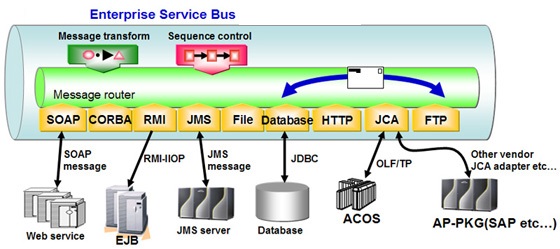
Karemind ESB serves as the foundation of the Karemind SOA Platform which adds the Karemind Event Process Orchestrator, Karemind Integration Studio, Karemind Deployment Manager and Karemind Adapters to form a comprehensive integration platform.
Global Leaders Choose Karemind
Karemind helps organizations worldwide improve operational efficiencies and business performance by sharing information dynamically across global operations. Our commitment to developing standards based solutions that deliver immediate ROI with proven interoperability and industry-leading reliability helps ensure our customers' sustained success in worldwide markets. . Karemind understands the development, infrastructure and performance challenges facing IT departments in today's hyper-competitive markets. Over 500 enterprises worldwide have deployed Karemind solutions, allowing them to
- Extract business value from existing business and legacy applications spanning multiple, cross organizational boundaries;
- Deploy in a cost effective, incremental fashion, without disrupting existing operations or major up-front investments;
- Meet dynamic surges in demand, deliver services without disruption and increase customer satisfaction without having to provision new hardware systems;
- Lower the cost of ownership and maintenance of IT systems via enhanced reuse of software assets and standards based implementations;
- Reduce training costs and reliance on outside consultants, allowing in-house developers to deploy and manage complex integrations;
- Enhance productivity by allowing business-analysts to compose business processes with minimal programmer intervention
Manufacturing
Leading manufacturers have selected Karemind over competing solutions for real-time process control across multiple platforms and applications over heterogeneous protocols.
Energy
Some of the largest oil and energy companies use Karemind to rapidly integrate disparate systems and harness silos of information in legacy systems to improve delivery of services. Oil companies use Karemind to get real time information from field to office enabling critical decision making by Managers that directly impacts the bottom line.
Banking and Financial Services
Leading financial institutions have selected Karemind solutions to deploy the next wave of flexible and adaptable core banking, risk management and trading solutions.
Telecommunications
Leading telecommunications companies use Karemind Software to deliver millions of messages daily across complex, distributed workflows in mission-critical 24x7 environments.
Retail, Real Estate and Hospitality
Some of the leading consumer service organizations use Karemind to significantly improve their net profits through streamlining of processes and connecting with trading partners.
Government /Defense
State and Federal Governments have deployed Karemind to significantly improve citizen services and increase revenue collections; Defense Agencies have used the solutions to significantly enhance their response and intelligence gathering activities.